
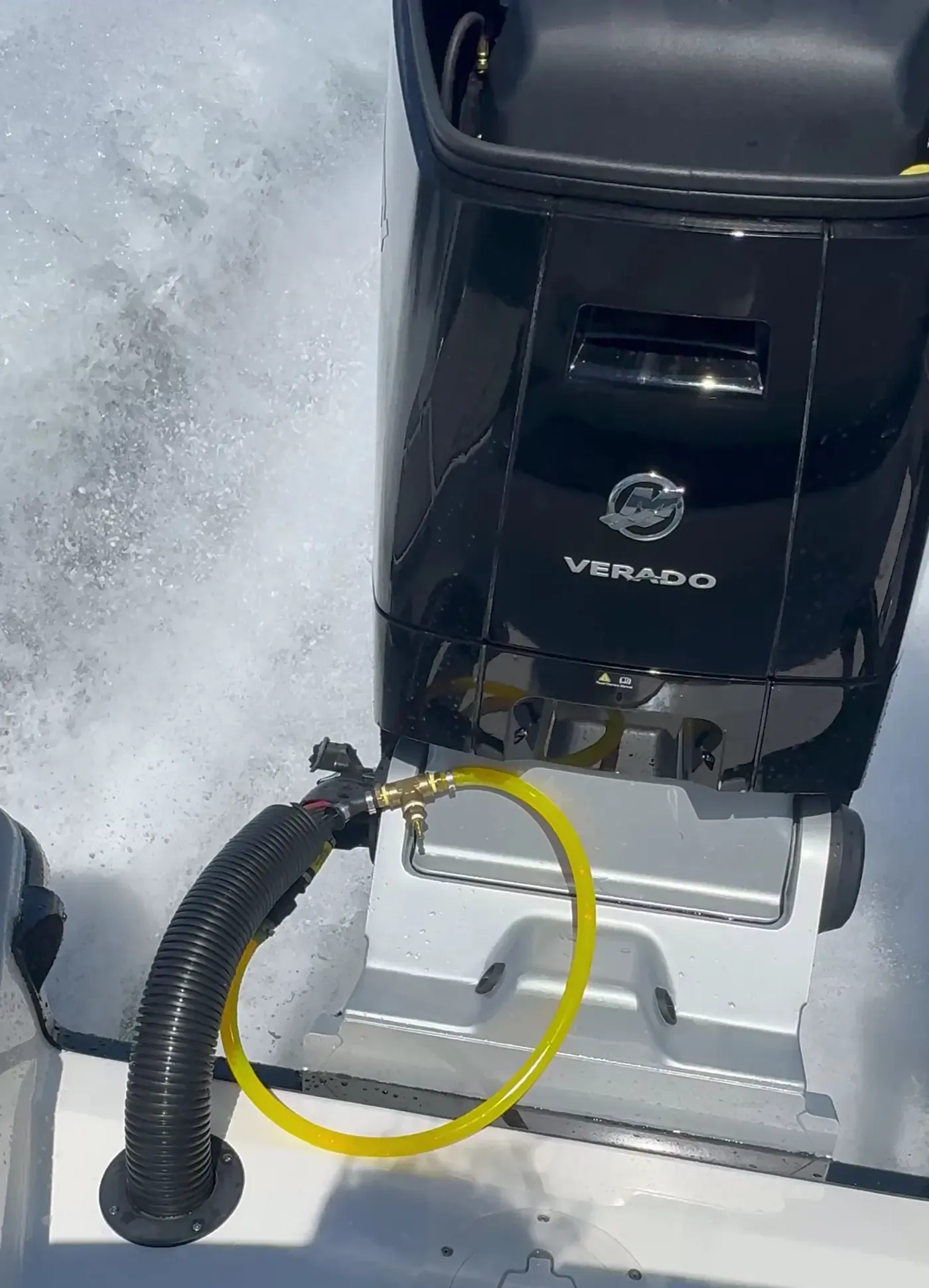
How raw-water cooling actually works
Here's the whole trick of a raw-water cooled engine: the lake is the coolant. A pump, turned by the driveshaft, sucks water up through the lower unit or the drive, shoves it through the powerhead or the block and around the exhaust, then dumps it back out the exhaust and the tell-tale. No reservoir. No radiator, no cap to check. About the only sign it's all working is water coming out of the engine — which is why a weak tell-tale stream gets treated like an emergency.
And since the lake's the coolant, whatever's floating around in the lake goes through your engine. Stir up sand and silt in the shallows and it grinds at the pump housing. Weed and junk clog the intake screens. Winnipesaukee's fresh, so you're spared the salt scaling a coastal boat lives with — but silt, sand and the seasonal weed still find the passages, and the more time you spend poking around shallow water near shore, the more you collect.
The impeller is cause number one
The impeller itself? A rubber wheel of vanes, spinning off-center in its housing. As each vane sweeps past the tight side, it bends, and that bending is what pushes the water along. Rubber doesn't like heat. Doesn't like getting old, doesn't like being left bent one way all winter either. Run it dry once — a few seconds on a flush, a start on the trailer — and the vanes can glaze over or tear. Lose a vane and the broken piece rides upstream and plugs a passage.
What kills impellers here is the short season. The lake ices over, ice-out usually gets declared somewhere around mid-April, and most boats go back in for a handful of months. So an impeller can be six or seven calendar years old with hardly any engine hours on it, and still be hard, set permanently in one shape, and cracked at the roots of the vanes. Years beat hours. Go by the engine's own service schedule, and count the calendar.
The tell-tale, thermostats and blocked passages
The tell-tale is that little stream squirting out of the side of an outboard. It's a diagnostic, not a cooling part: a bleed off the water jacket that shows you water's circulating. A strong, steady stream is good. Weak, on-and-off, or hot to the touch? Flow's been cut down somewhere in the system. And no stream at all means shut it off. Right then. Limping back to the ramp on a hope is how a pump job becomes an engine job.
Sometimes a healthy engine shows no stream just because the tell-tale tube is plugged — it happens a lot — so temperature gets checked, not only flow. Thermostats fail too. Usually they fail closed, which cooks the engine, or stuck open, which leaves it running cold and rich and carbonizing the combustion chambers. Corroded thermostat housings, sticky poppet valves and silted passages in the block all choke flow without any one part looking obviously broken.
What an overheat actually destroys
Keep running an engine that's overheating and the expensive stuff goes first. Aluminum pistons grow faster than the cylinder walls around them, so the piston scuffs, then grabs, and leaves vertical scores down the bore. Head gaskets let go. Heads warp out of true. On a two-stroke, an overheated cylinder can hole a piston crown outright. A new impeller won't fix any of that afterward; now it's a powerhead job. Don't argue with the temperature alarm.
Then there's the exhaust, which nobody thinks about. The rubber exhaust hose, the exhaust tube, the water-jacketed housings — they only survive exhaust heat because cooling water's running through them. Take the water away and they scorch, go hard and crack, and suddenly exhaust gas or water is getting where it should never be. So when the alarm sounds: engine off, look at the intake for whatever's blocking it, and call a tow. That last mile isn't worth it.
Closed cooling on inboards and sterndrives
Inboards and a lot of sterndrives use closed cooling, a two-circuit setup. The engine runs on a sealed loop of coolant and antifreeze, just like a car, and lake water cools that loop through a heat exchanger instead of air through a radiator. The raw-water side still has a pump. Still has an impeller, still fouls with silt and weed. The difference is the engine's internal passages stay clean. Half the system being closed doesn't make it maintenance free.
Closed systems need their coolant tested and replaced, because the corrosion inhibitors in it get used up over time and the block depends on them. Heat exchangers silt up and have to come off and get cleaned out. The good news: on these installs the raw-water pump usually hangs off the engine on a belt, so its impeller's reachable without pulling a drive. And when one of these engines overheats? Could be either loop. Step one is figuring out which one gave up.