
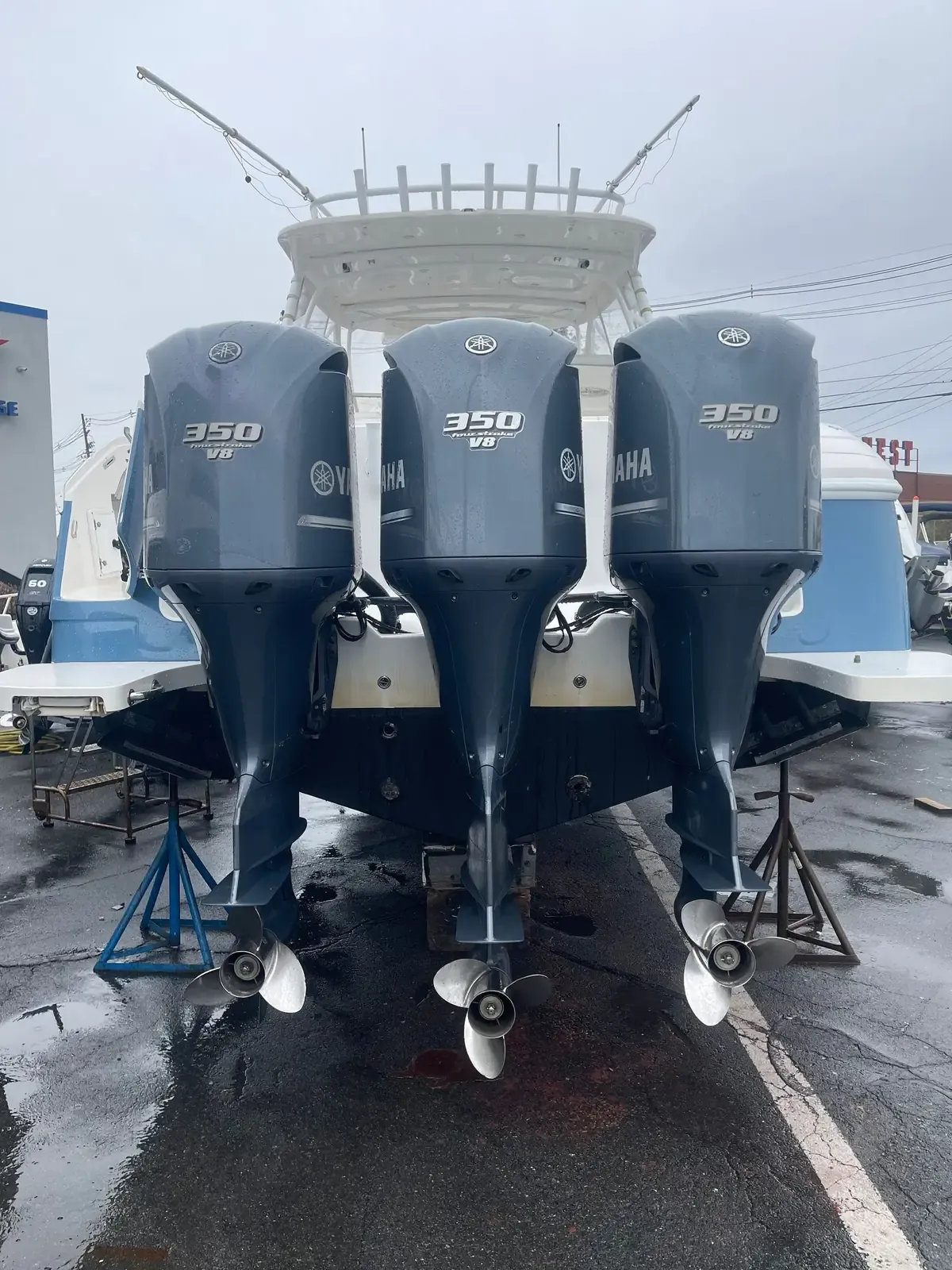
The Yamaha four-stroke range, from kicker to V8
Nearly every Yamaha on this lake is a four-stroke, but that covers a lot of ground. The little portables and the mid-size fours on runabouts and pontoons are simple inside — one camshaft, a few plugs, an oil filter, a fuel filter. Then you get to the offshore V6 and the 5.6-liter V8, and it's a different job. More cylinders and plugs. More oil. Not much room under the cowling. And wiring that expects a real battery bank, not whatever was least expensive at the store.
You mostly find the V8s on big boats that cruise rather than troll, and a lot of them hang in pairs, triples, even quads. Size and access change everything. The cowlings come off, engines get tilted, sometimes the boat gets moved, and what's an hour's service on a portable becomes most of a day on a big rig. Plan around that. It beats being surprised by it.
The annual pass
Oil and filter, gear lube, plugs, water pump, anodes, fuel filters: that's the list, but the order and the details are what count. Yamaha four-strokes are picky about oil level. You read it with the engine level, after it's sat a while — overfill one and that extra oil ends up somewhere you don't want it. Plugs come out and get read as a set. One that looks different from the others is telling you something about that cylinder before it's a part to replace.
Anything past that comes from the engine's own service schedule for that model and serial number. Yamaha publish owner manuals and maintenance info through their outboard owner resources, and what the small fours need isn't what the offshore engines need. We work to the manual for the engine in front of us. We don't run one generic list across every Yamaha on the lake; valve clearance checks, timing parts and drive-system items aren't shared across the range.
The water-separating filter and the warning system
Yamaha fit a water-separating fuel filter with a sight bowl and a float, and checking it is the most useful five seconds in an owner's pre-launch routine. Water in that bowl came out of the tank, and finding it there beats finding it in an injector by a mile. The element's a service item, not a permanent part, and on a boat that fills up at all sorts of docks it earns its keep every season.
The warning system is the other thing owners misread. Get an overheat or low-oil-pressure warning and the engine drops into a reduced-speed mode on purpose, to save itself. That's your cue: throttle back, look for telltale flow, shut it down. Pushing on to get home is the wrong call. An engine driven through a warning shows up at the shop with a different, far more expensive list of problems than one that got shut down the moment it complained.
Multi-engine rigs are not one service
Three engines means three oil changes, three gearcase drains, three sets of plugs, three water pumps, three sets of anodes. Plus three charging systems and three fuel paths, and on a networked rig, controls that have to agree among themselves about which engine is which. So a lazy shift, a throttle that's out of step, a gauge showing nothing — it looks like one engine's problem, and quite often it's the harness or the network in between.
The upside of a multi-engine rig? The engines check each other. Run the same tests across all of them and any outlier jumps out: lower compression on one, a cooler telltale, darker gear lube, a plug that reads differently from the rest. That comparison is free diagnostic information, and it's the first thing we use on a twin, triple or quad before anything comes apart.
Corrosion on a freshwater lake
Winnipesaukee's fresh water. There's no salt here, so the nasty outside corrosion that chews up saltwater outboards is mostly missing, and owners take that as a sign anodes don't matter. They still do. Anodes protect against galvanic action between dissimilar metals, and against stray current from shore power and from neighboring boats in a marina. A dock with badly wired power can eat an anode surprisingly fast, fresh water or not.
The freshwater problems here aren't missing, they're just different. Water left in a gearcase or a cooling passage through a New Hampshire winter freezes and splits castings. A boat kept on a mooring off Tuftonboro all season grows the same biological film in its cooling passages as anywhere else. Anodes get measured and replaced on condition, not on faith, and cooling passages get drained properly before the first hard freeze. Not after.