
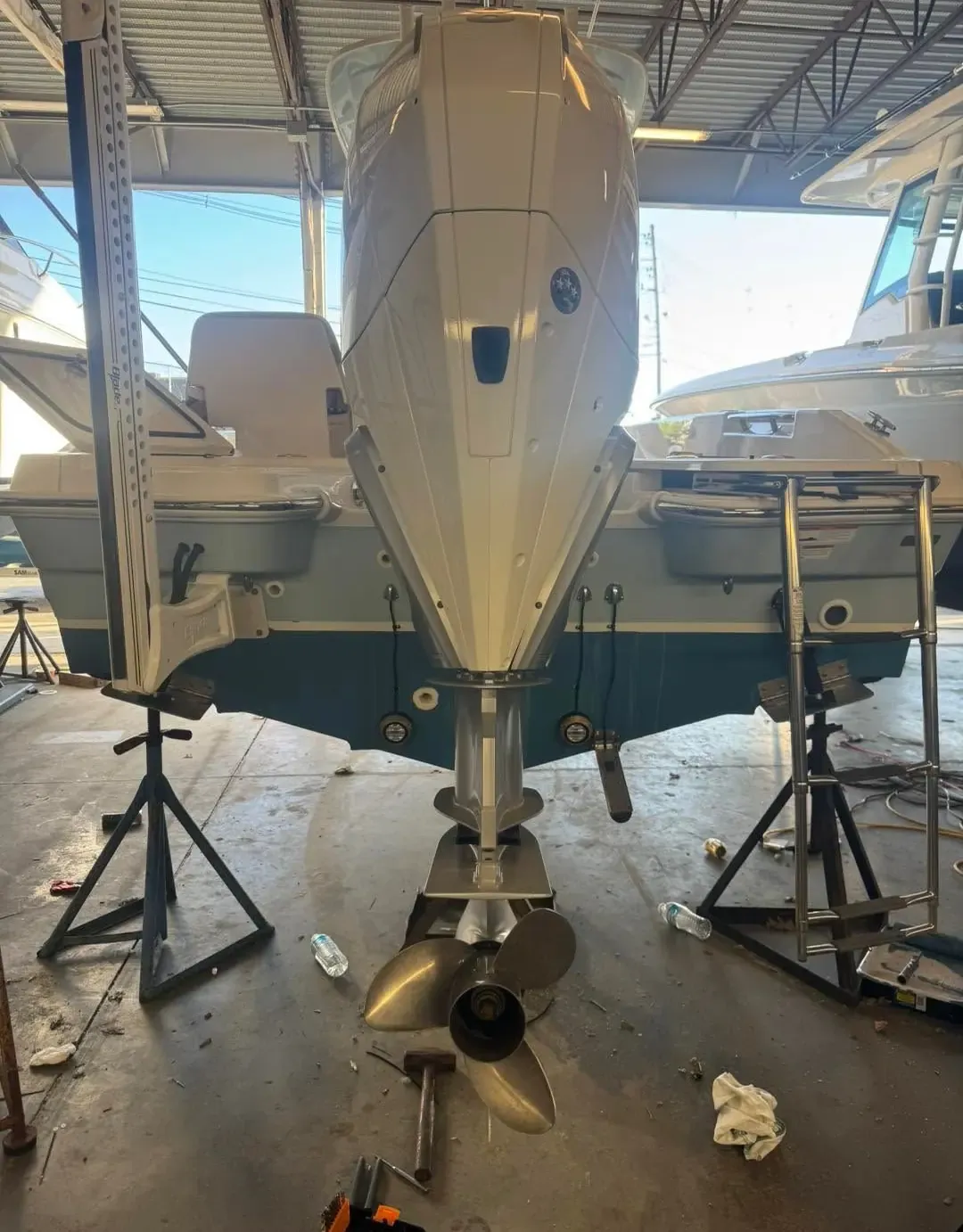
Pitch, diameter and what the tachometer tells you
Diameter's the circle the blades sweep. Pitch is how far the prop would move forward in one turn, in theory anyway. Put those two together and you've decided how hard your engine works. Too much pitch: the engine never makes it to the top of its rated RPM at wide open throttle. It lugs. Runs hot. Lives its whole life carrying a load nobody designed it for. Too little: it over-revs. Sure, the limiter steps in — you're still wasting gas and going slower.
So forget the top speed for a second and look at the tach. Every manufacturer publishes a wide-open-throttle RPM range, and with a normal load in the boat, the right prop gets you up near the top of it. Rule of thumb: an inch of pitch moves you something like 150 to 200 RPM, one way or the other. That's really all the math there is to a prop change — and it's why the prop that's perfect empty is wrong once six people and their gear climb aboard.
Dings, bent blades and where vibration comes from
Damage starts small. A ding on the leading edge. A curled trailing edge. One blade tip a few thousandths of an inch out of line with the other three. On the bench, none of it looks like much. Underwater, though, each blade's meant to pull its equal share once every revolution — and the one that's out of true just doesn't. That mismatch is the shake you feel in the deck and the wheel. Speed up and it gets worse.
A beat-up blade cavitates, too. The water tears away from that rough or bent edge, little vapor bubbles form and pop against the metal, and what's left is a pitted, chalky gray patch. You lose thrust. You get noise. And slowly, the prop gets eaten. Chip metal off the tips and the effective diameter shrinks, so the RPM creeps up, and now the real problem's hiding behind a tach number that quietly changed. Take the prop off to check the blades. That's the only way you see all of it.
A spun hub, and how it is diagnosed
Most props drive through a rubber or plastic hub bonded between the barrel and the splined insert. It's meant to fail. Its job is to take the hit, so an impact doesn't travel straight into the gearcase. When that bond finally lets go, the engine revs up free and the boat hardly moves — you'll notice it most punching the throttle or backing up. Ask an owner and they'll all say pretty much the same thing: it feels like it's slipping instead of driving.
Want to know if the hub's spun? Grab a marker. Draw one line across both the barrel and the insert, take the boat out, then come back and see whether the two halves of your line still meet. Partial spin is common, and it comes and goes, so people end up blaming the drive or the transmission. In most props the old hub presses out and a new one goes in, for a lot less than a new prop. Just don't blame the gearcase for a rubber part.
Stainless or aluminum, and who reconditions it
Aluminum props are softer, and they cost less to buy and less to fix. They flex under load (that costs you a little performance), and when they hit something they bend rather than fight. Stainless blades are thinner and stiffer and keep their shape, so more of the engine's output reaches the water. But stainless doesn't give in a strike. Something else does: the hub, the shaft, or the gearcase. Neither one's right everywhere, and on a lake with rock in it, plenty of owners carry an aluminum spare.
Reconditioning is specialist work, and it goes to a prop shop. Straightening, rebuilding a leading edge, re-pitching to a measured spec and balancing all need that shop's equipment, so that's where they're done. What happens here is the part on either side. Pulling the damaged prop. Checking the hub, the shaft and the seal behind it. Fitting the spare so you keep running, then fitting the reconditioned prop once it's back. And anodes on the drive still matter in fresh water: no salt means slower corrosion, but stray current in a marina doesn't care about salinity.
What vibration does to everything downstream
Vibration isn't a comfort thing. When a prop's out of balance, every single turn it shoves the shaft sideways. Over and over. That works the prop shaft seal until it starts to weep, and then water gets into the gear lube (the lower unit page has that part in full). The shaft bearings take a beating too. Give it a season and a straight shaft can come out bent — and on a sterndrive, all that load travels back into the gimbal bearing and the couplers.
And the hits that start all this? Nothing unusual around here. Winnipesaukee has granite ledge and boulders sitting just under the surface, especially in the shallows around its islands, and there are at least 264 of those islands. One hit at speed can bend blades, spin a hub and slam the gearcase, all at once. So after any contact, take it in order. Prop off. Blades and hub. Shaft runout. Then the gear oil.