
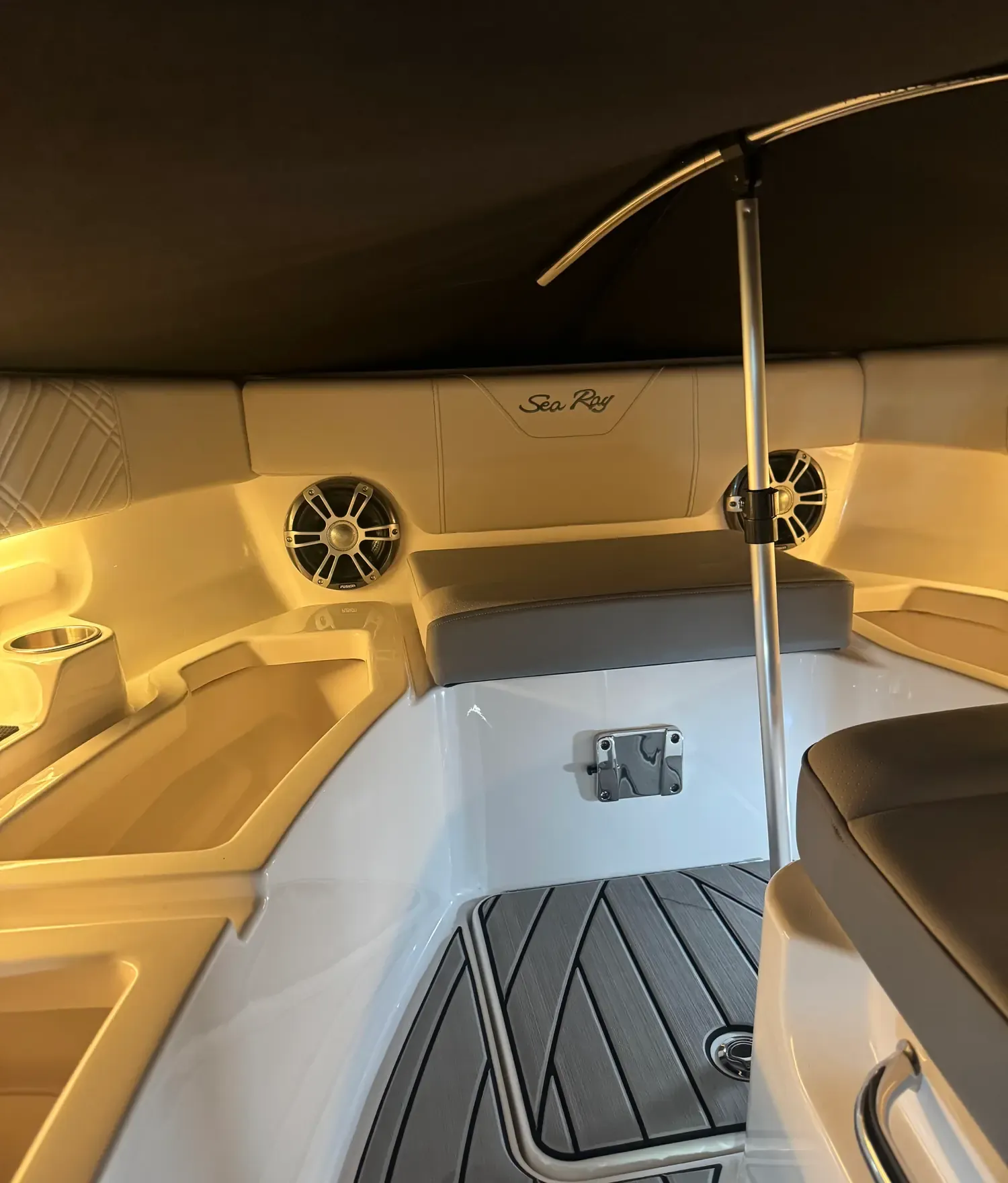
What gets installed
Plotters, fishfinders and their transducers; VHF radios and antennas; a stereo and speakers; courtesy lights, underwater lights. Then the stuff people add a season or two after they bought the boat — another battery, more switches, charging gear, a bilge pump, trim and gauge add-ons.
Doing it so it survives the winter
Wire that's marine-grade and big enough for the run. The fuse or breaker up at the source, never down at the device. Terminations sealed. Where the transducer goes, decided before anyone drills. And cable runs held up properly, so three seasons of shaking don't saw them open against a stringer.
The standards that govern this on recreational boats are published by the American Boat and Yacht Council, and they exist because the failure modes are well known and entirely avoidable.
Where the power comes from
When marine electronics get thrown in fast, the problem usually isn't the device, or the mount, or even the wire size. It's where the power comes from. Tie a plotter, a stereo amp or a string of underwater lights into whatever circuit was handy, and sure, it works on the trailer. Then at cruise the alternator, the bilge pump and everything else are pulling at the same moment, and it starts acting up.
Doing it right: a feed sized for the load, coming off a sensible distribution point, fused or breakered where it starts rather than where it ends, and a ground path laid out as carefully as the positive. Got more than one battery? Then somebody has to decide which bank this thing lives on. Most kits never even raise the question.
The result is an installation that behaves the same in August as it did the day it went in, and does not quietly flatten a starting battery overnight at a mooring.